Long chromatic names are hard to sing fluidly in drills, dictation, and sight-singing.
Completely Singable Letter-Name Pitch Identity
SingLet™ gives every written note a short, singable label while keeping its letter-name identity clear.
A more singable way to name written notes, especially once chromatic spelling gets too bulky to speak or sing fluidly.
ISME 2026
Presented in the 37th annual ISME 2026 and MISTEC.
Accelerate musical literacy with a more intuitive symbol-to-sound-to-name bridge.
Start using SingLet confidently in 5 minutes.
Make absolute pitch widely learnable instead of rare.
Natural notes
| Note Names | A | B | C | D | E | F | G |
|---|---|---|---|---|---|---|---|
| SingLetTM | A | B | C | D | E | Fi | G |
| SingLet sounds | A | Bee | Cee | Dee | Ee | Fi | Gee |
| IPA | /eɪ/ | /bi:/ | /si:/ | /di:/ | /i:/ | /fi:/ | /dʒi:/ |
Sharp notes
| Note Names | A♯ | B♯ | C♯ | D♯ | E♯ | F♯ | G♯ |
|---|---|---|---|---|---|---|---|
| SingLetTM | Ah | Bah | Cah | Dah | Eah | Fah | Gah |
| SingLet sounds | Ah | Bah | Sah | Dah | Yah | Fah | Gah |
| IPA | /ɑ/ | /bɑ/ | /sɑ/ | /dɑ/ | /jɑ/ | /fɑ/ | /gɑ/ |
Flat notes
| Note Names | A♭ | B♭ | C♭ | D♭ | E♭ | F♭ | G♭ |
|---|---|---|---|---|---|---|---|
| SingLetTM | Aeh | Beh | Ceh | Deh | Eeh | Feh | Geh |
| SingLet sounds | Aeh | Beh | Seh | Deh | Yeh | Feh | Geh |
| IPA | /ɛ/ | /bɛ/ | /sɛ/ | /dɛ/ | /jɛ/ | /fɛ/ | /gɛ/ |
Problem
The Gap SingLet Is Trying To Solve
Chromatic note names get awkward to sing when accidentals pile up.
Spoken accidentals are bulky in performance.
SingLet proposes compact labels for fixed-pitch practice while remaining compatible with relative-pitch work.
How It Works
How SingLet Works
The pattern is simple: the starting sound identifies the note family, and the ending sound pattern identifies the accidental tier.
Natural notes stay recognizable
The natural notes keep the familiar letter names A, B, C, D, E, and G, while F shifts to Fi for smoother singing.
Starting sounds stay stable
Each letter note family keeps the same starting sound, so the label still points back to the note letter you know.
Accidentals change the ending pattern
Sharps, flats, and higher tiers are marked by systematic ending-sound changes, giving each note spelling its own compact sound.
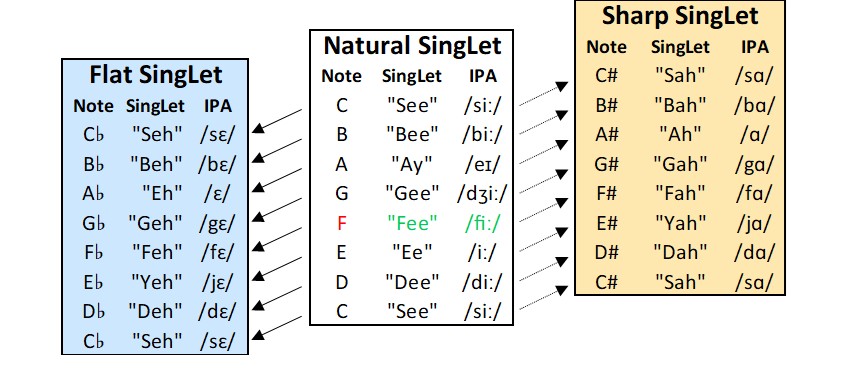
Comparison of flat, natural, and sharp SingLet™ tiers
Simple rules: each letter note family keeps the same starting sound, while each accidental tier shares the same ending sound pattern; the chart shows the flat tier with IPA on the left and the sharp tier on the right.
In Practice
Pilot Audio Snapshots
These early classroom and learner samples are meant to show the project in use. They are pilot snapshots, not polished curriculum recordings.
01
MARCH 17, 2026
Snapshot 2: 新agaabc在北京
0:00
0:00
A short classroom-style phrase that lets visitors see the notation and hear the matching pilot audio together.
Research Status
Research And Publication Status
The SingLet paper is moving toward full-paper publication. The public site should frame the work honestly as an active research and pedagogy project, not an established standard.
Contact
Contact
SingLet is led by Fuping Zhu with co-author John Mo. The project is open to educator outreach, pilot interest, and future collaboration.
FAQ
FAQ
Common questions, kept lower on the page so the explanation and proof come first.
What is SingLet™?
SingLet™ is a completely singable letter-name solmization and gives every written note a short, singable label while keeping its letter-name identity clear.
Why create a new note-naming system?
SingLet™ was created to provide a systematic, singable, and expandable naming system for all diatonic and chromatic pitches while preserving direct correspondence with standard letter-note notation.
Continue Exploring
Start with the system if you want the clearest explanation, or jump to pilots if you want to hear SingLet in use first.