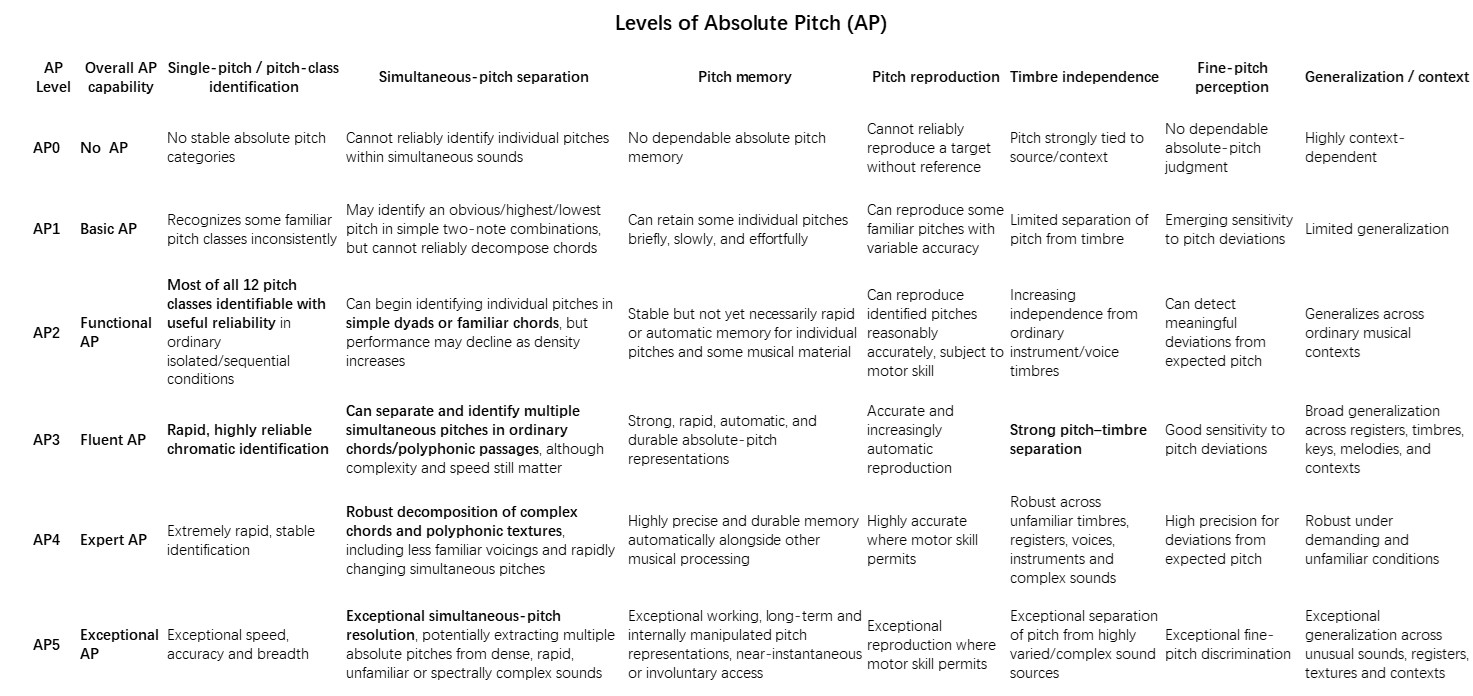
A proposed framework for understanding the breadth, reliability, and integration of absolute-pitch abilities.
From a rare gift to a spectrum of abilities
Absolute pitch (AP) is often said to occur in just 1 out of 10,000 people (0.01%), an estimate reported by Levitin and Rogers. (Levitin and Rogers 2005) We consider this probably too pessimistic as a description of the full range of AP-related abilities: a definition centered on exceptionally accurate, reference-free pitch naming may overlook partial, emerging, or context-dependent capabilities. This is our interpretation of the estimate's limitations, not a revised population estimate or a claim that the original figure specifically measured our proposed AP5 level.
Research supports considering a continuum of AP performance. In computerized testing of 51 musicians, Bermudez and Zatorre found performance ranging from perfect to random, with a substantial group showing intermediate proficiency. (Bermudez and Zatorre 2009) They also emphasized that test design and scoring affect the distribution observed. (Bermudez and Zatorre 2009) Separately, Levitin's work showed that memory for the pitch of familiar music can exist without conventional pitch labeling. (Levitin 1994) Together, these findings motivate a broader account of pitch abilities, although they do not establish how common each ability is in the general population.
Language proficiency offers a useful analogy for classifying continuous ability. The U.S. Interagency Language Roundtable (ILR) scale uses six base levels, numbered 0 through 5. (Defense Language and National Security Education Office 2022) The Department of Defense's April 2022 speaking descriptors name them: 0, “No Proficiency”; 1, “Elementary Proficiency”; 2, “Limited Working Proficiency”; 3, “General Professional Proficiency”; 4, “Advanced Professional Proficiency”; and 5, “Functionally Native Proficiency.” (Defense Language and National Security Education Office 2022) Intermediate plus ratings, from 0+ to 4+, recognize performance between base levels. (Defense Language and National Security Education Office 2022) Europe's Common European Framework of Reference for Languages (CEFR) offers a similar approach with levels A1-C2, grouped into basic, independent, and proficient language use. (Council of Europe n.d.)
We propose the AP Levels table below, drawing on evidence for a continuum of AP ability and the analogy to the ILR's 0-5 classification. The levels describe useful capabilities across a range of proficiency; they do not imply a direct equivalence between language and AP ratings.
AP Levels Table
By analogy with language-level classifications that describe continuous language proficiency, we propose the AP0-AP5 levels below to describe a continuum of absolute-pitch capabilities. This research is independent of SingLet. The levels describe profiles across several dimensions of pitch ability; they are not a validated assessment scale.
Proposed AP levels across pitch identification, simultaneous-pitch separation, memory, reproduction, timbre independence, fine-pitch perception, and generalization. Capabilities may differ across dimensions; a listener need not fit every descriptor in one row.Open the AP Levels Table PDF
Reading the six proposed levels
AP0
No AP
No stable absolute pitch categories. Cannot reliably identify individual pitches within simultaneous sounds. No dependable absolute pitch memory. Cannot reliably reproduce a target without reference. Pitch strongly tied to source/context. No dependable absolute-pitch judgment. Highly context-dependent.
AP1
Basic AP
Recognizes some familiar pitch classes inconsistently. May identify an obvious/highest/lowest pitch in simple two-note combinations, but cannot reliably decompose chords. Can retain some individual pitches briefly, slowly, and effortfully. Can reproduce some familiar pitches with variable accuracy. Limited separation of pitch from timbre. Emerging sensitivity to pitch deviations. Limited generalization.
AP2
Functional AP
Most/all 12 pitch classes identifiable with useful reliability in ordinary isolated/sequential conditions. Can begin identifying individual pitches in simple dyads or familiar chords, but performance may decline as density increases. Stable but not yet necessarily rapid or automatic memory for individual pitches and some musical material. Can reproduce identified pitches reasonably accurately, subject to motor skill. Increasing independence from ordinary instrument/voice timbres. Can detect meaningful deviations from expected pitch. Generalizes across ordinary musical contexts.
AP3
Fluent AP
Rapid, highly reliable chromatic identification. Can separate and identify multiple simultaneous pitches in ordinary chords/polyphonic passages, although complexity and speed still matter. Strong, rapid, automatic, and durable absolute-pitch representations. Accurate and increasingly automatic reproduction. Strong pitch-timbre separation. Good sensitivity to pitch deviations. Broad generalization across registers, timbres, keys, melodies, and contexts.
AP4
Expert AP
Extremely rapid, stable identification. Robust decomposition of complex chords and polyphonic textures, including less familiar voicings and rapidly changing simultaneous pitches. Highly precise and durable memory automatically alongside other musical processing. Highly accurate where motor skill permits. Robust across unfamiliar timbres, registers, voices, instruments and complex sounds. High precision for deviations from expected pitch. Robust under demanding and unfamiliar conditions.
AP5
Exceptional AP
Exceptional speed, accuracy and breadth. Exceptional simultaneous-pitch resolution, potentially extracting multiple absolute pitches from dense, rapid, unfamiliar or spectrally complex sounds. Exceptional working, long-term and internally manipulated pitch representations, near-instantaneous or involuntary access. Exceptional reproduction where motor skill permits. Exceptional separation of pitch from highly varied/complex sound sources. Exceptional fine-pitch discrimination. Exceptional generalization across unusual sounds, registers, textures and contexts.
Understanding the dimensions
Single-pitch / pitch-class identification
This dimension describes how accurately and quickly a listener identifies an individual pitch or pitch class. Pitch-class accuracy and octave accuracy should be scored separately: Miyazaki found that reliable pitch-class identification could coexist with octave errors. (Miyazaki 1989)
Simultaneous-pitch separation
Naming one isolated tone and extracting several notes from a chord place different demands on the listener. In our proposal, this column describes increasing ability to resolve concurrent pitches. Chord density, spacing, timbre, and presentation speed should be specified when evaluating it; the proposed progression is a research question.
Pitch memory
This dimension concerns the stability and accessibility of remembered pitches. Levitin found that some listeners could reproduce familiar songs near their recorded pitch without conventional pitch labeling, supporting a distinction between remembering a pitch and naming it. (Levitin 1994)
Pitch reproduction
This dimension describes producing a target pitch through singing or an instrument without a supplied reference. Evaluate accuracy and consistency separately from recognition, accounting for vocal range and motor control. A listener may recognize a pitch accurately while having difficulty reproducing it.
Timbre independence
This dimension concerns recognizing pitch across different sound qualities, such as piano, voice, or pure tones. Miyazaki found that identification accuracy varied with timbre, so familiarity with one sound source should not be treated as evidence of equivalent recognition across others. (Miyazaki 1989)
Fine-pitch perception
Recognizing a note category and judging a small tuning deviation are distinct assessment tasks. This column proposes sensitivity to deviations around an expected pitch. A useful evaluation would record tuning error in cents, specify the tuning standard, and distinguish reference-free judgments from comparisons with a supplied tone.
Generalization / context
This dimension describes how well abilities carry across registers, keys, melodies, textures, and unfamiliar listening conditions. It extends beyond timbre alone. Evaluate performance across these contexts rather than assuming that success in a familiar task transfers automatically; Miyazaki's register-dependent results illustrate the importance of varying test conditions. (Miyazaki 1989)
Using the framework
Van Hedger, Heald, and Nusbaum found that some adults achieved strong AP performance after training, while most participants made modest gains. (Van Hedger, Heald, and Nusbaum 2019) Their findings support investigating learning while recognizing individual differences.
Record a profile across dimensions rather than forcing every listener into one row. Specify the pitch set, tuning, register, timbres, number of trials, response time, and scoring rules. Test without a supplied reference, record possible internal-reference strategies, and assess naming, reproduction, and simultaneous-pitch identification separately. Repeated sessions can help distinguish stable performance from a single successful attempt.
References
Bermudez, Patrick, and Robert J. Zatorre. 2009. “A Distribution of Absolute Pitch Ability as Revealed by Computerized Testing.” Music Perception 27 (2): 89–101. https://doi.org/10.1525/mp.2009.27.2.89.
Defense Language and National Security Education Office. 2022. “Interagency Language Roundtable Skill Level Descriptions for Proficiency – Speaking.” April 2022 edition. U.S. Department of Defense. https://www.dlnseo.mil/Resources/ILR-SLD/DoD-ILR-Speaking/.
Levitin, Daniel J. 1994. “Absolute Memory for Musical Pitch: Evidence from the Production of Learned Melodies.” Perception & Psychophysics 56 (4): 414–23. https://doi.org/10.3758/BF03206733.
Levitin, Daniel J., and Susan E. Rogers. 2005. “Absolute Pitch: Perception, Coding, and Controversies.” Trends in Cognitive Sciences 9 (1): 26–33. https://doi.org/10.1016/j.tics.2004.11.007.
Miyazaki, Ken'ichi. 1989. “Absolute Pitch Identification: Effects of Timbre and Pitch Region.” Music Perception 7 (1): 1–14. https://doi.org/10.2307/40285445.
Van Hedger, Stephen C., Shannon L. M. Heald, and Howard C. Nusbaum. 2019. “Absolute Pitch Can Be Learned by Some Adults.” PLOS ONE 14 (9): e0223047. https://doi.org/10.1371/journal.pone.0223047.